
Your project's knowledge.
Made Clear.
TRACE helps AEC teams understand where information lives, why decisions were made, and how knowledge flows across projects.
Most teams don’t struggle because information is missing. They struggle because knowledge is scattered across models, documents, systems, and people — making decisions harder to trust.
TRACE provides a clear, structured view of your project knowledge — without changing the tools you already use.
Where Project Knowledge Breaks Down
Information exists, but is hard to locate
Decisions are made, but context is lost
Systems work, but not together
Teams spend time searching, checking, and asking
Confidence depends on “who you ask”








The cost is not just time — it’s uncertainty, rework, and fragile decision-making.
Start with a Clear Picture
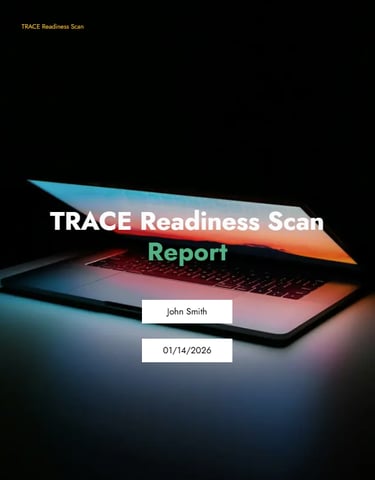
The TRACE Readiness Scan gives a practical snapshot of how your project knowledge performs across the five layers.
IT SHOWS:

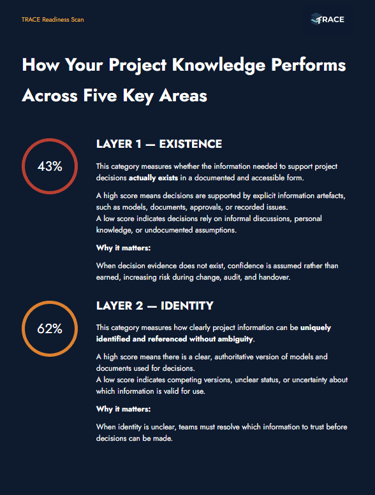
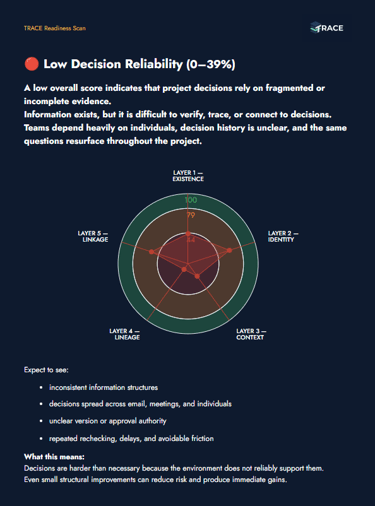
Where clarity is strong
Where friction appears
Where small changes can create immediate impact
The Five Layers of Project Knowledge Clarity
Through research and field work in Scandinavian AEC projects, TRACE identified five layers that determine whether project knowledge is usable, trusted, and decision-ready.
1. Existence
Where information lives — and whether it has a clear home
2. Identity
How easily answers can be found and recognized
3. Context
Why decisions were made — and where that reasoning lives
4. Lineage
How information flows between systems and tools
5. Linkage
How quickly knowledge can be found and trusted in practice
Weakness in any layer creates friction — even if the others appear strong.
From Fragmented to Connected
Clarity doesn’t arrive all at once
Most AEC teams move forward in stages as structure, ownership, and information flow gradually align.
At early stages, the most valuable improvements are not technical.
They are about creating shared understanding and reducing dependency on individuals.
What typically comes first:
agreeing where final information lives
making ownership explicit
reducing duplication before adding new systems
This is normal — and fixable.
TRACE is designed to support teams after these foundations are in place — not to replace them.
When Clarity Compounds
From design through handover, TRACE supports information access across every phase.
Low clarity
Teams search, verify, and rely on individuals
Improving clarity
Structure exists, but friction remains under pressure
High clarity
Information is predictable, decisions are trusted, systems support the work
Clarity is not a single fix — it compounds as structure, context, and connection reinforce each other.
Test Deeper Connection — Without Disruption
For teams with a solid foundation, a focused TRACE pilot can test how connecting decisions, models, and documents changes daily work — without introducing new tools or processes.
PILOTS ARE:
Small and contained
Based on real project data
Designed to learn, not commit
From Clarity to Capability
At high levels of clarity, project knowledge becomes more than organized — it becomes a strategic asset.
Understand decisions months later without reconstruction
Search across systems with confidence
Reduce rework and verification loops
Prepare for AI-assisted knowledge retrieval
Pilot FAQs
Does TRACE require access to all our project data?
No. TRACE pilots are scoped to a defined project and a defined information set. You control what is included, what is excluded, and where data remains stored.
Where does our data live during a pilot?
TRACE does not replace your systems of record.
Data remains in your existing environments unless explicitly agreed otherwise.
Is TRACE compliant with AEC data governance expectations?
TRACE is designed to work within existing BIM, document, and governance structures — not around them.
What risk are we taking by running a pilot?
The purpose of a pilot is to limit risk, not introduce it.
Success criteria are defined upfront, and the pilot can be stopped at any time.
Does TRACE make or automate decisions?
No. TRACE supports access and traceability of information.
Decision responsibility always remains with the project team.
What happens if the pilot doesn’t show value?
Then you’ve learned something at low cost, on a limited scope — and no further commitment is required.
Who is typically involved from our side during a pilot?
A pilot is intentionally lightweight and typically involves a small number of project roles, not a full rollout team.
How long does a pilot take?
Typically weeks, not months — scoped to fit delivery reality.
What happens after the pilot?
You decide — scale, refine, or stop.
Does this require IT involvement?
Minimal. TRACE works with existing systems.
Get in touch
TRACE
NBL Consulting ApS.
CVR-nummer: 46053915
Contacts
info@trace4data.dk
NLB Consulting ApS. Denmark © Copyright 2025
TRACE Built from hands-on delivery in complex, regulated AEC projects — where decisions must be traceable, trusted, and auditable.